A Brand Promise Is Not Yet a Decision Rule
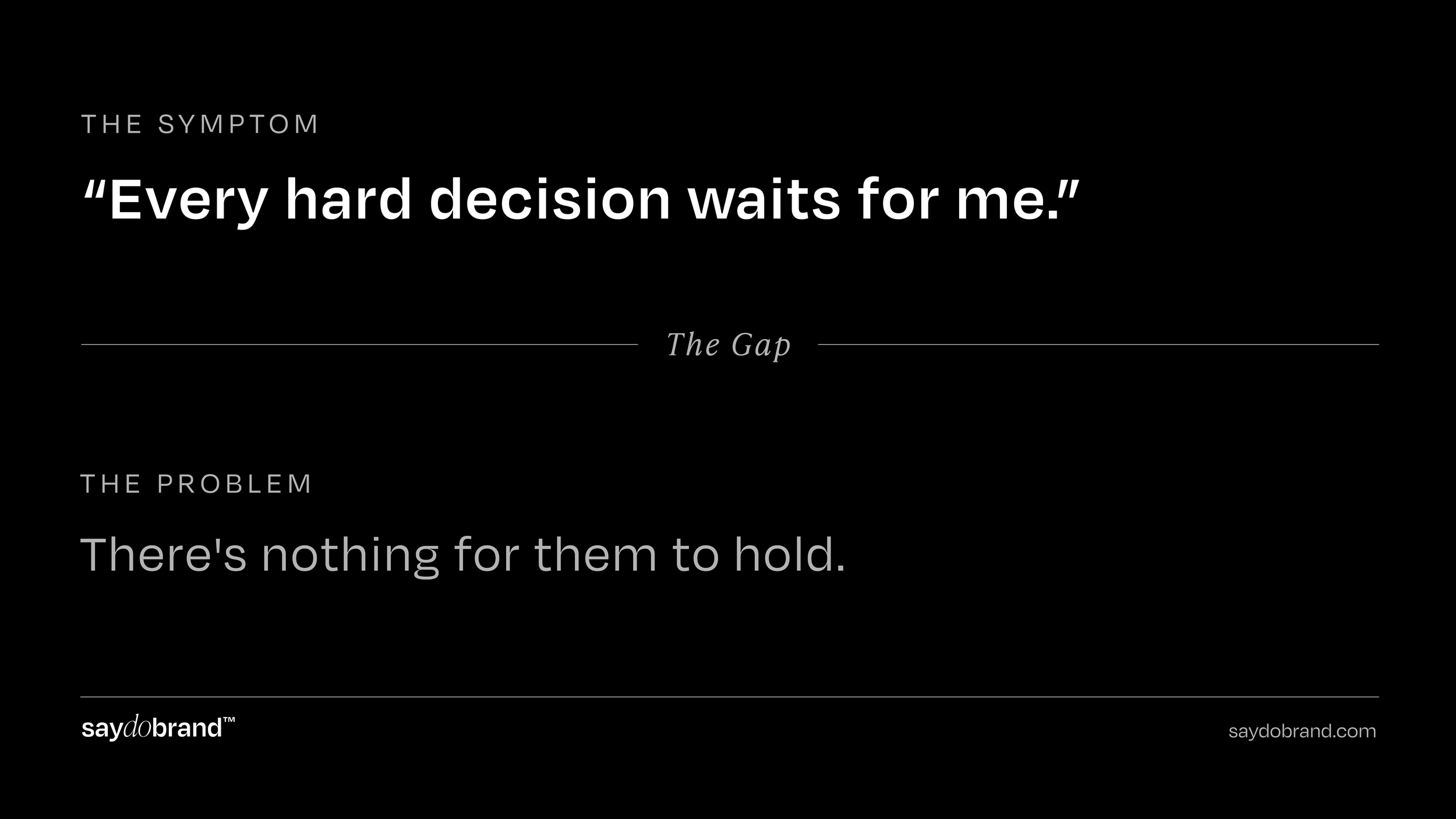
The meeting should have taken ten minutes.
A leadership team has a customer request on the table. The answer affects margin, delivery strain, and a promise the company repeats often. Two leaders make reasonable cases. Nobody doubts their intelligence. Yet the room turns toward the founder.
The same choice has arrived before under different names. A sales exception. A hiring compromise. A service recovery. Each time, the company has waited for the person who can translate the promise into a decision.
That's not a values problem. It's not a messaging problem.
I've learned that a brand promise becomes useful only when two capable leaders can reach the same difficult answer without its author in the room. That's the Say-Do Gap™ in its operating form. The words may be clear. The judgment isn't transferable yet.
One leadership team faces a late request that would make one customer whole and quietly teach everyone that deadlines are optional. It protects the delivery standard, declines the shortcut, and gives the service leader authority to make a narrow remedy without rewriting the rule. The answer is difficult. The standard holds.
I work with a founder whose leadership team can sell the product in its sleep. Features. Specs. Quality. What the team can't carry is the reason the company exists. So when a buyer pushes on price, the room has no rule to hold. The promise says the company is different. Nobody can name what that difference refuses. The discount request escalates. The founder decides, again, because only the founder can explain why the price is the price. Every deal that closes this way teaches the market to compare the company on features and cost. Rivals move in. The product didn't slip. The judgment never transferred.
The difference isn't conviction. Both founders believe what they say. The difference is whether the belief has been turned into a rule a team can use when the choice costs something.
A decision rule makes four things plain:
What it protects. Name the standard that can't be traded away casually.
What it refuses. State the shortcut, exception, or behavior that breaks the promise.
What counts as a real exception. Define the boundary before a pressured moment arrives.
Who can apply it. Put judgment with an owner who doesn't need founder interpretation to act.
Run the Decision-Rule Test on one promise this week.
Choose language your company already uses. Then ask a leadership team to write the protected standard, the refusal, the exception boundary, and the operating owner without consulting you. Compare the answers.
If the answers scatter, the promise is still a founder-held idea. If they converge, you have the beginning of an operating standard.
Don't use this exercise to produce a cleaner values statement. Use a current decision with real consequences. Give the team thirty minutes, not a week. Make them choose the refusal they'd sustain when the easier answer wins applause in the room. A rule becomes credible when it guides a decision before the founder is asked to rescue it.
The transfer question is harder: could the team use that rule in sales, delivery, hiring, and customer experience without bringing every version back to you?
Most companies don't lack values. They lack transferable judgment.
That gap creates a familiar cascade. Decisions slow down. Exceptions multiply. Leaders protect themselves by escalating. Customers receive different versions of the same promise. The market starts comparing you on price. The founder becomes the company's live translation layer.
A promise that cannot survive a trade-off is not yet a decision rule.
The quarterly cost is larger than one delayed meeting. It's the accumulated drag of decisions that should have been owned lower in the organization, the quiet erosion of standards, and the proof customers receive when the pressure is real.
Start with one promise. Watch where the room looks when the choice costs something. That reflex tells you whether your language has become an operating standard.