Every Company Runs on a Belief. Most Are Running on a Stand-In.
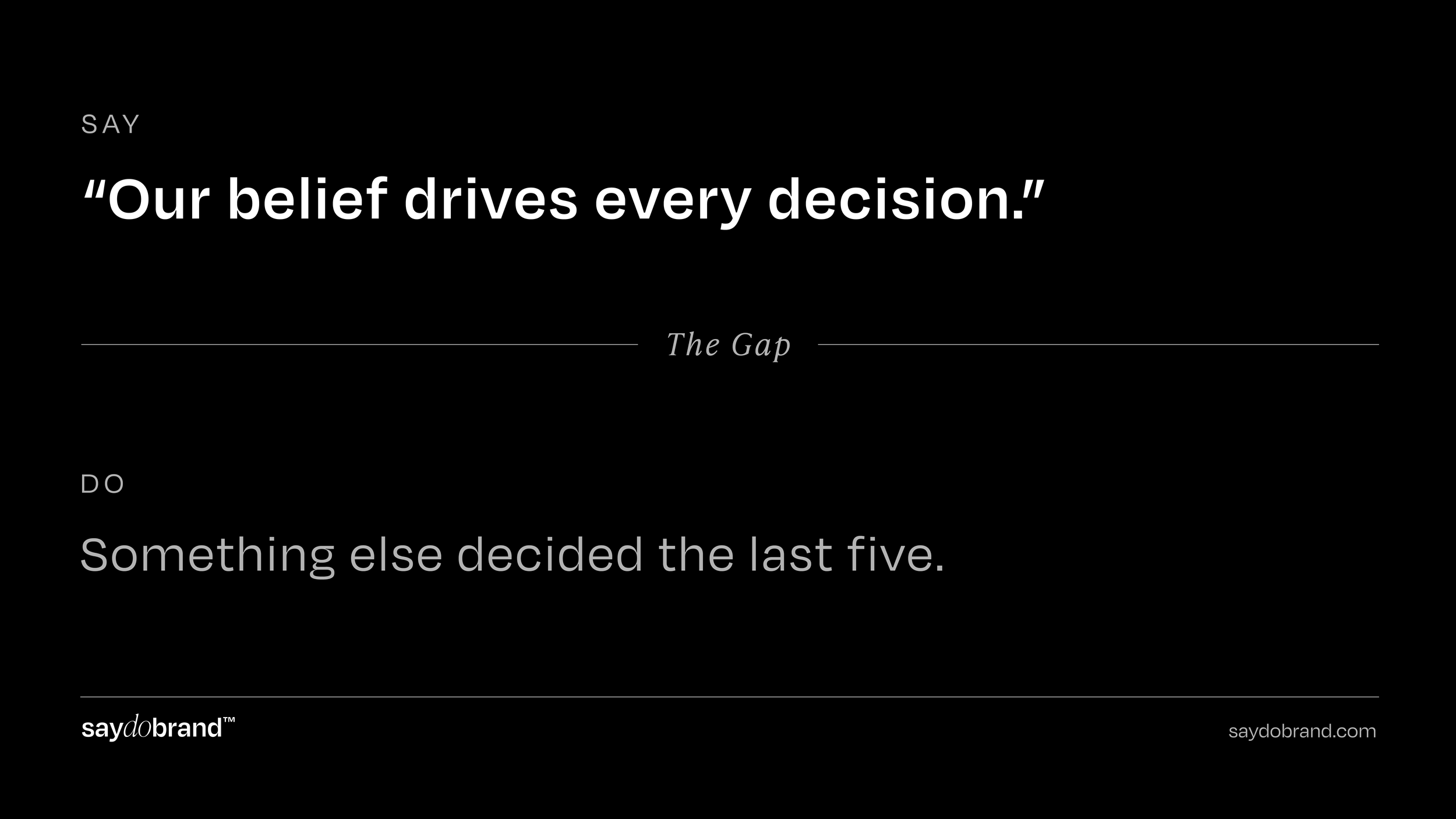
Your company doesn't have a belief. It has a sentence.
The sentence is in the lobby. It's on the careers page. It got read aloud at the offsite and nobody argued with it, which should have been the first clue. A belief gets argued with. A belief costs money. A sentence just sits there and agrees with everyone.
Here's the test, and it's one question. What has your company lost on purpose because of what it believes?
Not lost by accident. Not lost and rationalized afterward. Chosen. A deal walked away from. A product shelved. A price held while the whole category discounted. If you have an answer, you have a belief. If the question feels unfair, you have a sentence.
Most companies have a sentence. And a sentence can't decide anything. So something else does.
Every company has a lead role: the belief, the conviction the company exists to prove. When that role is empty, and in most companies it is, a stand-in takes the part. A stand-in is whoever's available when the lead doesn't show. Yours has been on stage for years. The audience noticed before you did.
Meet the understudy
There are five, and you'll recognize yours by what it costs.
Revenue. Believes whatever the quarter needs. Cost: the first discount taught everyone the price is a suggestion. Now the exceptions are the policy.
Product. Believes in the thing you make. Cost: the roadmap became the strategy, and when a competitor ships the same feature nobody can say why the customer should stay.
Speed. Believes in shipping. Cost: quality became a conversation instead of a standard, and the word "exception" stopped sounding like one.
Consensus. Believes whatever the room can agree to. Cost: values everyone approved and nobody can quote.
You. Believes whatever you decide today. Cost: every hard call routes to your chair, and the company can't say no unless you're in the room.
None of these is a villain. Each is a reasonable thing to optimize. The defect is the same in all five: a stand-in can't refuse anything. It has no "no" in it. Revenue never declines a customer. Product never kills its own feature. Consensus never holds a price under pressure. You can say no, but only in person, which means your company can't.
And a company that can't say no can't be believed. Trust is built entirely out of the things you refuse.
It's not what's on the wall
Ask a founder what the company believes and watch the reach for the wrong drawer. The mission. The values. The purpose. The positioning. All real. All useful. None of them ever turned down a dollar.
Some say it straight: we exist to make money, or to make the best product. Respect the honesty. Then watch what it does. Money never turns away a check. Product never retires its own feature. Those are stand-ins with the paperwork done.
Some exist to be better, cheaper, or faster than the company next door. An -er brand. Not a belief. A comparison. And a comparison moves every time the neighbor does.
And some have nothing in the drawer at all. A fragrance manufacturer called me about launching a brand. Booming category, a factory, formulas, capacity. No reason for the brand to exist except the boom. I asked what line they'd draw. What flag they'd plant that the next manufacturer with a factory wouldn't. What would keep them from chasing the next trend or thinning the formula the first time a retailer leaned on price. Silence, then the honest answer: they hadn't thought about it. That's how most brands are born. A brand born without a belief doesn't grow one by accident. It gets a stand-in on day one, and by year three the stand-in has a logo.
So, the definition. The only one that survives contact with a P&L.
A belief is a conviction about how the world should be, held strongly enough that the company will lose money to honor it.
That last clause is the whole thing. A belief is the only thing in your company with a "no" in it.
What one looks like
A jeweler I work with doesn't run sales. Not Valentine's. Not Mother's Day. Not the six weeks from Black Friday to Christmas when the whole category shouts percent-off in forty-point type. No sale. Ever. Name another jeweler who does that.
Ask why and you don't get a pricing strategy. You get a conviction: the moments people walk in for are among the biggest of their lives, and a moment like that deserves to be honored, not converted. The enemy has a name inside the company. Transactionalism. A sale is a transaction trying to happen. So they don't run one.
Ask what it costs and you get a number nobody posts. Every season, on purpose. That's the point. Anyone can drop a price. Nobody can fake never having dropped one.
Patagonia is the same thing at scale. The belief came before the company: a climber who loved the places he climbed. In 1972 he stopped selling pitons, his best-selling product, because they were scarring the rock. Belief first. Then the decision that cost something. Fifty years of those decisions later, the jackets aren't better than the ones hanging next to them, and the market pays full price anyway. If Patagonia existed to make money, or to make better, cheaper, faster gear, it would be a different company. Probably a dead one.
The belief is the moat. The behavior is how you can tell it's there.
Recasting
I've spent twenty years watching companies say one thing and enforce another, and the fix has never once been a better sentence. It's three moves. Each has a test, so you can't grade yourself on intention.
Name it. Do you have one? Pull the last five decisions that cost the company something it wanted. A deal. A hire. A ship date. A margin. Next to each, write what really decided it. Not the stated reason. The real one. Three of five on the same conviction: that's your belief, and it's been running the place without a name. Five different answers: you just met your stand-in.
I ran this with a leadership team several months back. Mission framed in the lobby. Everyone in the room could recite it. Five decisions, four drivers: the quarter, the roadmap, the room, and whoever outranked everyone that day. Not one was a belief, because there wasn't one to use. Nobody was lying. There was no belief in the building.
You don't invent one. You excavate it. And you don't shape one to fill a gap in the market. A belief built for positioning is a stand-in in a nicer suit.
Build it. Does anyone besides you know it? Three leaders write it, one sentence each, no prep, no peeking. If the sentences don't match, the belief lives in one head. The company has access to it. It doesn't have it.
Write it precisely enough that someone who isn't you could make a costly decision from it without asking. When it's finally accurate, you'll flinch. Too narrow. Too binding. That's how you know it's finished. A belief you could never fall short of is a slogan. The risk is the credential. You aren't becoming someone new. You're going on record as who your decisions already say you are.
Live it. When did it last cost you? This quarter, not in the founding story. A belief with no recent invoice is a memory.
There are three things a company can do with a named belief, and only one counts. Claim it: website, wall, deck. Dead on arrival, because everyone claims. Witness it: write about real behavior, which has soul only if the behavior happened. Behave: shelve the line, decline the account, hold the price, before anything gets written. Soul lives there and nowhere else. Most companies run it backward. They write first and hope.
What it's worth
The distance between what you believe, what you say, and what you do is the Say-Do Gap™. Employees feel it first. Customers feel it next. The market prices it before you notice.
Close it and the gains are concrete. Pricing holds, because price becomes a consequence of the belief instead of a negotiation. Hiring sharpens, because you finally know what you're hiring for. Decisions speed up, because there's a standard to measure them against. And the company learns to say no without you in the room.
Competitors can say what you say. They can't pay what you're willing to pay.
Brand isn't what you say. It's what you enforce.
The question
Not what your company does. Not what the wall says.
What does your company believe strongly enough to lose money over?
If the honest answer is "I'm not sure anymore," ask the one underneath it.
Who's been playing the part?