Every College Sent My Daughters the Same Flyer. Every Category Does.
A brand doesn't live in the flyer. It lives in the one number nobody will print on it.
In my house that number has six figures in it. Four years of tuition, housing, and everything a family stops buying to afford them. It was the only thing anyone at our kitchen table wanted to talk about.
The first flyer showed up in September. A glossy 9x12 with a sunset over a quad, four students laughing at nothing, and a headline promising my daughter would "discover who she's meant to be."
By October the mailbox couldn't close.
Then the emails started, and they came to me. Somewhere a test score had turned my seventeen-year-old into a row on a spreadsheet, and a purchased row gets a purchased campaign.
I've done this twice. The first time all the way through, with a daughter who started college this fall. The second time is happening right now, with a senior in the house and a counter I can't see anymore. Here's what I noticed this time that I only half noticed the first.
I couldn't tell them apart.
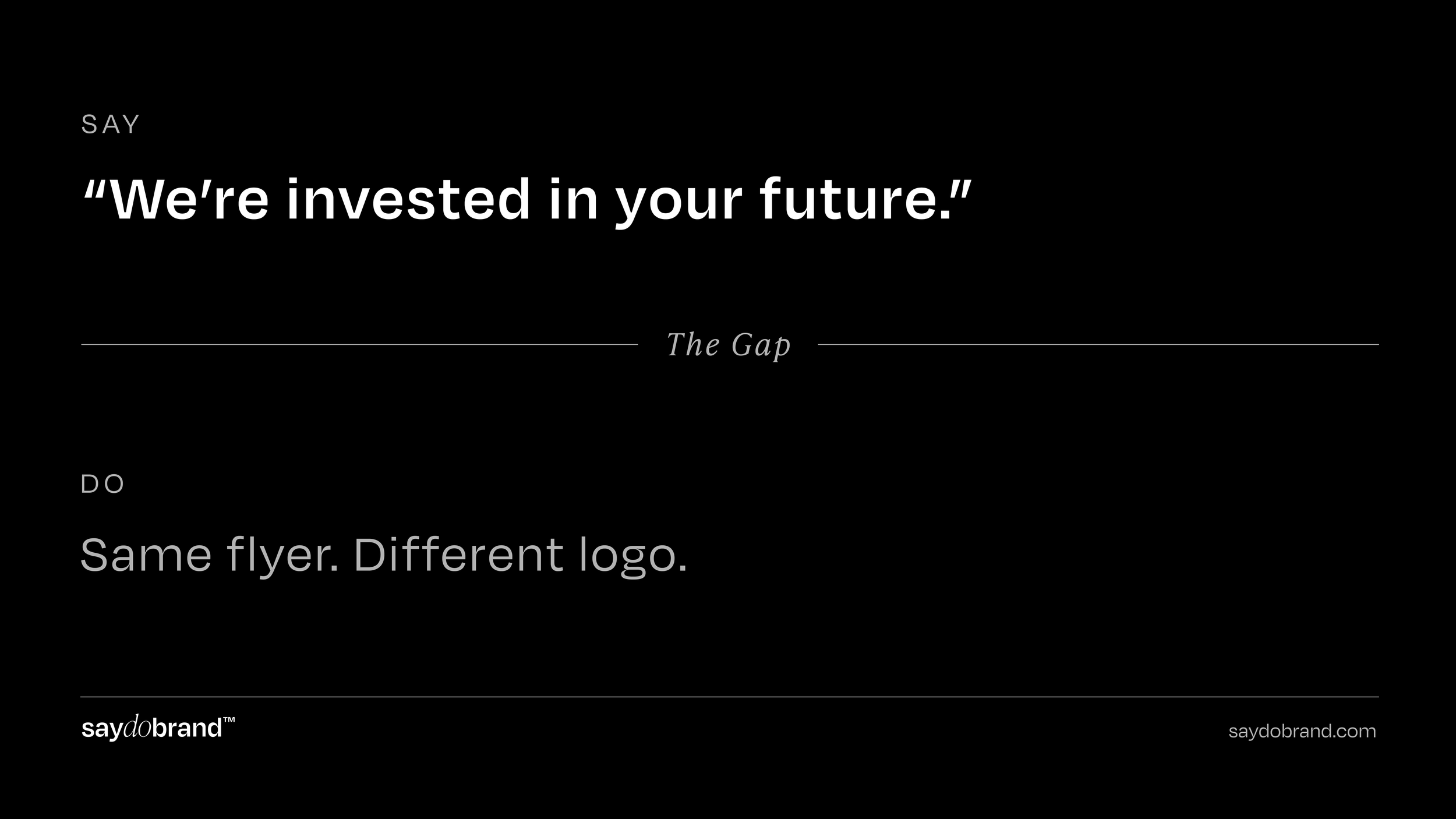
Not the small schools from the big ones. Not the privates from the publics. Not the ones two hours away from the ones two time zones away. Same photography. Same "world-class faculty." Same "vibrant community." Same "we're invested in your future." One night I laid a dozen of them side by side on the kitchen table and covered the logos with my hand. My daughter couldn't name a single one.
The only thing that varied was the color palette.
The question at the table
I should say why I was opening them at all. I opened every one of those envelopes hoping a school would give me a reason to keep believing the trade made sense. That's what a parent is doing with a flyer. Looking for permission to say yes.
Every flyer answered a different question instead: why should she come here rather than somewhere else?
The question at our table was why she should go anywhere at all. Will she come out of this with debt she can't outrun? Will there be a job on the other side of it, or a degree that looks nice in a frame? Is four years and six figures still the right trade, or just the trade everyone made before her?
That's the conversation happening in the kitchen while the flyer sits unopened on the counter. Thousands of schools, every one of them full of smart people, and every one of them decided not to touch it. Each one says it's invested in your future. Then each one spends its acquisition budget proving it's invested in your enrollment. The story is self-reported. The mailbox is the evidence.
What a school would do if it meant the line
Behaviors a parent could observe from the kitchen table without opening the envelope.
Put the number on the mailer. Median debt at graduation and median salary two years out, by major, on the front, where the sunset used to be, instead of buried in a federal disclosure. The first school to do that stops competing with the other eleven flyers on the table. It becomes the only one that told the truth first.
Tell some kids not to come. An admissions counselor who says "you'd be better off doing two years at community college and transferring in, and here's how we'll hold your spot" just did something no brochure can do. She cost the school a year of tuition and bought a family's trust for life. Every family that kid's parents talk to hears that story.
Carry the risk you're asking the family to carry. "If you graduate and aren't working in your field within six months, we cover your loan payments until you are." Now the school has skin in the same game the student does. Now "we're invested in your future" reads like a contract.
Freeze the price. Publicly. For years. It's been done. Purdue held tuition flat for more than a decade and told everyone why. A decision, repeated, that a parent can verify without trusting a single word of copy.
Send one letter instead of forty. Signed by a human. Asking a question instead of answering one. "What are you most afraid of about the next four years?" Then actually reply.
Notice what all five have in common. Every one costs something. Every one can be seen from the kitchen table. None of them needs a copywriter.
What a family feels toward that school is simple. They told us the truth before they had to. You can't write that feeling. You can only earn it, and then point at it.
The safe question
Colleges are the example. The pattern belongs to every category.
When everyone in a category aims at the same customer, using the same data, at the same moment, they all end up answering the same safe question. Why us? Look at us. Here's what we have. The safe question puts the seller at the center, and it's safe because a truthful answer costs nothing.
The unsafe question is the one the customer is actually asking. It's unsafe because answering it truthfully costs something. It might cost you the sale.
So the category quietly agrees not to ask it. Nobody votes. Everyone hires from the same pool, reads the same case studies, buys the same lists, and ships the same sunset. Then someone in the building calls the sameness a differentiation problem and hires a design firm to fix it. The sameness is the receipt. It proves nobody in the category was willing to pay for a different answer.
What it costs to stay in the sea
You keep buying the same list your competitors buy, so your acquisition cost climbs every year while your response rate falls. You keep answering the question nobody asked, so the buyer defaults to the only variable left, which is price. And because you never took a position that cost you anything, nobody can point to a reason you deserve the premium.
The deal may still close. What you lose is the right to be chosen for anything other than being cheapest or closest.
Sameness isn't a failure of imagination. It's a refusal to pay.
The Kitchen Table Test
Two questions. Run them before Friday. You don't need anyone's permission.
Cover the logo. Lay your last piece of outbound beside your closest competitor's with the names hidden, and hand both to someone on your team. Can they tell which one is yours? If they can't, you have a palette.
Put the question your buyer is actually asking at their kitchen table beside the last thing you published. What did answering it cost you? If the honest number is nothing, you haven't answered it yet. What you would have to give up, refund, refuse, or publish to answer it is the differentiator. The copy is just the receipt.
Most teams find the unsafe question in an hour. Then they find out whether the founder is willing to pay for the answer.
Back at the table
My older daughter picked a school this spring. A person told her something true when it would have been easier not to, and that settled it. The flyer had nothing to do with it. Her sister is deciding now, and the flyers are still coming.
Every one of them says the same thing on the front. Every one of them leaves the same number off. The distance between those two is the Say-Do Gap™.