Your AI Already Decided What You Believe.
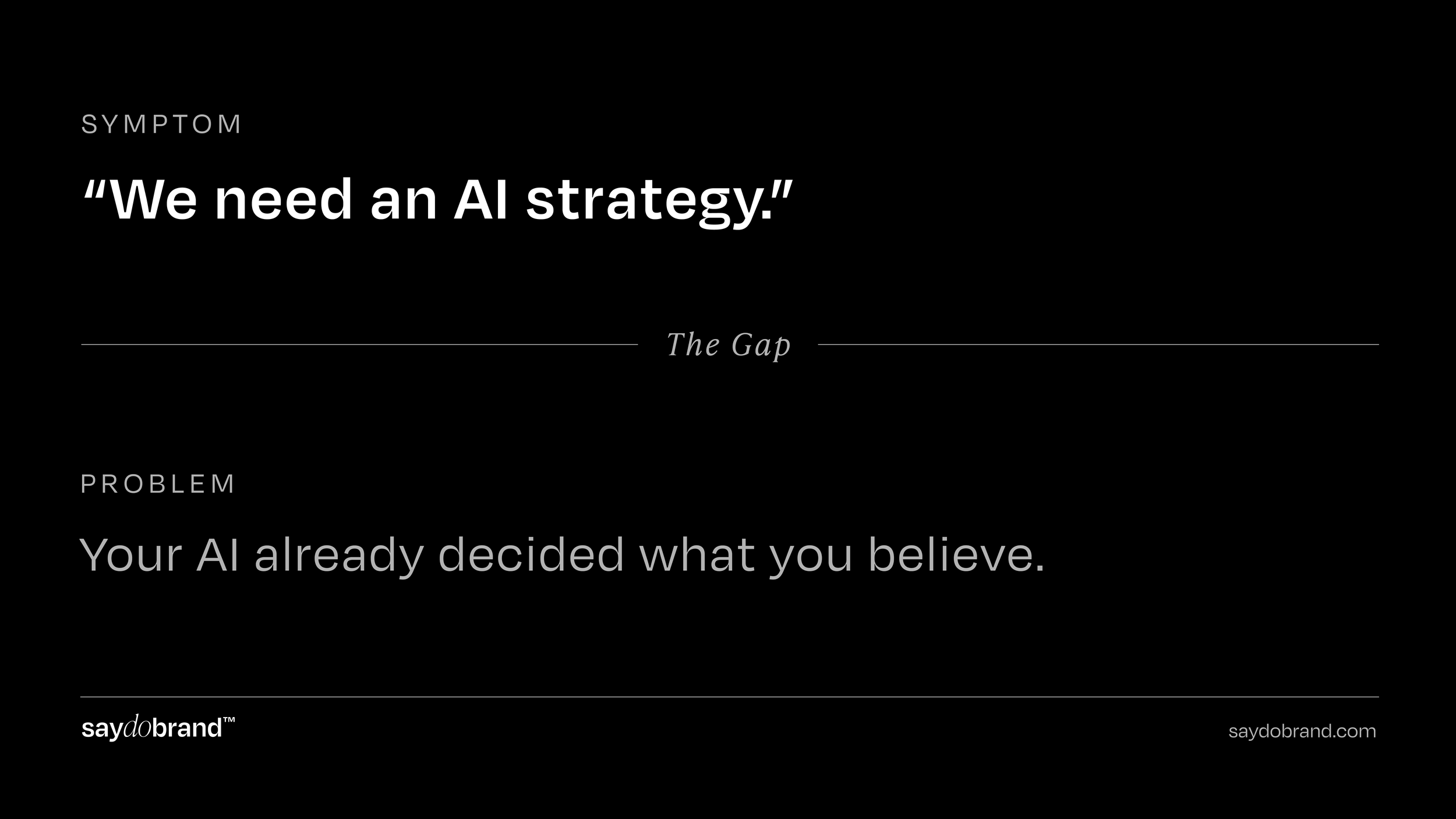
If your company hasn't defined what it believes, your AI already has.
AI is about to make your company more of whatever it already is. If what you believe is clear, defined, and true, it scales that. If it isn't, AI fills the space with something that sounds right and sends it to every customer you have.
This year I built an AI chief of staff on the best models money can buy. It runs pieces of sales, pipeline, and operations across my companies. At one point it was burning about a hundred dollars a day.
I'm not complaining about the bill. I'm telling you what I was paying for.
What a hundred dollars a day bought
The first drafts were good. Clean, confident, on message. They could have run. Not one of them was something I believe.
It had my website, my offers, my files. It didn't have the thing I'd pay to stand behind. So it made that part up, and it made it up well. Read those drafts cold and you'd think the company stood for something. It stood for whatever the average of my category stands for.
Garbage in used to come out as garbage. Now it comes out polished. It looks better. It sounds better. It still smells.
So I sat down and did the thing I tell clients to do. I wrote down what I believe. What I'll refuse even when it costs me. How I decide when nothing covers it. Then, last, the rules for how it sounds. Every one of those was something I'd carried in my head for years. The machine had been guessing at it, and so had the people around me.
The problem was never the model. It was that I'd never made the belief real enough to hand over.
What AI uses when you haven't decided
I do this for a living, and almost every founder I talk to this year has an AI line item. A tool, a consultant, a team told to use it more. The conversation is always which model, which workflow, which prompts.
That's the second question. The first is what the machine is using as its guide. If your belief is undefined, or defined but untrue, or true but sitting in your head instead of in front of the tool, your AI is running on something else. Its best guess at what a company like yours would say. Which is your competitor's website, averaged.
Your customers can't see the prompt. They read the answer looking for one thing: a reason to believe you're the company they chose. Here's the trap. The answer will sound like it. It will sound like conviction. Then they'll call, or show up, or ask for the thing it promised, and meet the company that never decided.
Louder, not truer
Before AI, the distance between what you say and what you do leaked one conversation at a time. A rep who overpromised. A new hire who didn't get it. You caught some of it. AI removes the catching. It publishes a belief you never chose to every inbox you have, every hour, in your name. Drift that used to take years can happen in a quarter.
The Smell Test
Take the question your customers ask most. Have AI answer it using only what's on your website and in your shared files. No coaching. No edits.
Print it. Read it as the founder, with a pen in your hand.
Ask two questions of every line. Do I believe this? Did we behave it this month? Circle every line that gets a no to either.
The circles are what your AI is using as its guide right now. Each one is a promise your company is about to make at scale and won't keep. Fix those before you touch a prompt.
AI can't believe anything for you.
Mine is better now, because I decided what it stands for. That's the order it works in, for a one-person company or a five-hundred-person one.
The distance between what your AI says you believe and what your company actually does is the Say-Do Gap™.